
Jones JDF Release Boundaries
The Jones County Sheriff's Department operates the Juvenile Detention Facility in Ellisville, but JDF is not part of the public adult released-inmate roster. Juvenile proceedings and records carry separate confidentiality rules. No public list should be built from youth custody information, and no adult booking card should be treated as a substitute.
A youth may leave JDF because a juvenile court authorizes return to a parent or guardian, orders another placement, or directs a transfer. The exact possibilities depend on the individual court matter. Research did not identify a public JDF release-reason field, destination list, or historical release feed. Only the authorized facility or court channel can characterize what happened.
Confirm a Jones JDF Release
Confirmation begins with authority, not a public name search. A parent, guardian, attorney, court-authorized advocate, or other person with a lawful role should contact JDF or the juvenile court handling the matter. Staff may need to verify identity and authority before sharing even basic status. Respect that step and do not seek workarounds through adult databases.
- Identify the responsible juvenile court and the relationship that permits the inquiry.
- Call JDF through its published number and ask which authorized channel handles status or release questions.
- Provide only the identifiers staff requests through that official channel.
- Ask whether the matter is a release, a transfer, or another court-directed placement, if disclosure is permitted.
- Obtain any order or confirmation from the court or facility rather than relying on online absence.
The Jones County adult release-record path is relevant only when an adult booking exists. It must not be used to reconstruct a juvenile matter. Sealed, restricted, or juvenile information should remain unavailable when the lawful custodian cannot disclose it.
Jones JDF Contact Channel
The sheriff publishes the facility address and main number. It does not publish JDF release hours, a public release-record form, a fee schedule, or public walk-in rules. Contact the facility before traveling. Ask what proof of identity, relationship, or court authority is required and which office can respond.
Jones County Juvenile Detention Facility
5172 Highway 11
Ellisville, MS 39437
Phone: 601-649-7500
Hours: Published public inquiry hours unavailable
The Mississippi Public Records Act does not turn every record into an open record. Juvenile, sealed, medical, security-sensitive, and identifying material can be withheld or limited. The custodian decides what is held and what may lawfully be disclosed. An authorized requester should describe the record precisely and accept a lawful redaction or confidentiality response.
Jones JDF Is Not ADF
JDF and the Adult Detention Facility are separate subjects, even though the sheriff operates both on Highway 11. The adult facility publishes a 48-hour Released view with booking cards. JDF does not belong in that product. Applying adult roster fields, photos, booking numbers, or public-release assumptions to a youth would erase the key privacy boundary.
The distinction also affects language. A missing adult card is not a “no record” result for JDF. A youth's move to another authorized placement is not necessarily community release. A court order may control who receives the child and what can be shared. The safest public statement is that verification is unavailable through adult public channels.
The sheriff's official detention page lists JDF separately from the adult jail.
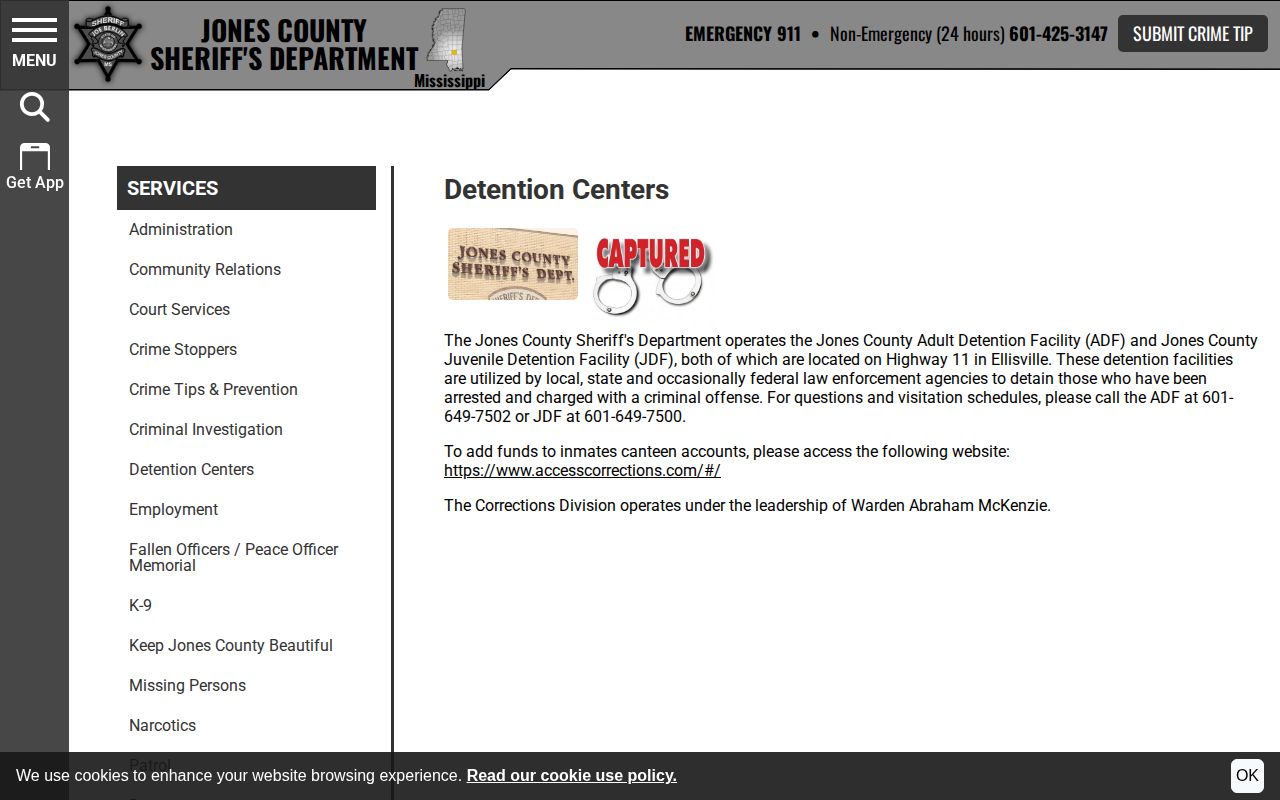
The image confirms the facility identity and contact route while preserving the central rule that juvenile release details are not an adult public roster product.
Protect Jones Juvenile Records
A legitimate need for information does not cancel confidentiality. Do not post a young person's name, image, home address, school, family contacts, case plan, or placement details to seek public help. Do not use cached adult pages, social posts, or unrelated records to infer the outcome of a juvenile case. If the court or facility says the information is restricted, the public inquiry ends there.
Court records explain legal authority only when the requester can lawfully access them. Even then, an order and the physical movement record can answer different questions. The court may authorize a change before facility processing is complete. Ask the authorized custodian for the current answer and note the response date.
Jones JDF Placement Changes
Research Angle T concerns mixed local, state, and occasional federal use at the adult facility. It does not support claiming that JDF has the same mixed-custody handoffs. For JDF, the supported point is narrower: a juvenile court or facility channel must distinguish a return to a lawful guardian from transfer or another placement. No public destination field was verified.
This distinction keeps adult and juvenile records from being blended. It also prevents the word release from being used where a court-directed move is more accurate. Ask for the exact term the authorized record uses. If it cannot be disclosed, report only that no public verification is available.
Jones JDF Unpublished Details
No public source reviewed gave routine JDF release times, an exit location, property rules, transportation arrangements, weekend or holiday procedures, visitor waiting instructions, or a records fee. Those facts must not be borrowed from ADF or another county. The facility can give current, case-appropriate instructions to an authorized caller.
Call ahead and keep the question narrow. Ask which office has authority, what proof is needed, and whether any releasable confirmation exists. Do not ask staff to disclose protected details merely because an adult roster would display them in an adult case.
Separate Jones Adult Searches
The adult Released feed contains photos, names, booking numbers, ages, timestamps, charges, and bond data for adult booking episodes. None of those public fields should be expected for JDF. Searching the adult feed may help only when the person is in fact an adult with an adult booking. It cannot confirm a youth record by omission, a similar name, or a family connection.
VINELink also depends on participating-agency feeds and is not a promise of public juvenile coverage. MDOC searches state corrections, not local juvenile placement. BOP and ICE are separate federal systems. Using each tool only for its documented population protects both accuracy and confidentiality. When no public juvenile channel applies, the answer is an authorized facility or court inquiry.
Document Jones JDF Answers
An authorized caller should note the office contacted, date, scope of the question, and exact response. A facility answer may confirm only that staff cannot disclose status. A court answer may identify an order without revealing placement. Neither response should be expanded through guesswork. If instructions require an identity check, appointment, attorney request, or court filing, follow that authorized process. No routine public workflow was found, so those steps must come from staff for the actual case.
Accuracy also requires care with time. A court may authorize a move before processing ends, and a lawful placement can change. Ask whether the response is current and which record controls. Do not keep checking the adult feed for a youth. The absence will never become proof, no matter how long it lasts. If disclosure is denied, preserve the privacy boundary and report that no public verification is available.
Do not ask the adult jail line to interpret juvenile custody through an adult booking search. JDF's published number is the direct facility route, while the juvenile court controls its own orders and access rules. If a caller is referred from one office to another, note the referral and ask which custodian holds the exact record. A lawful no-record or nondisclosure response should be kept with the date and scope. That response proves only what the office searched or could release. It does not prove where a youth went, when a move occurred, or whether another confidential placement exists.