
Where Jones ADF Releases Go
The Jones County Sheriff's Department operates the Adult Detention Facility for adults held by local, state, and occasionally federal agencies. That mixed use makes destination as important as the release timestamp. Someone may leave after bond conditions are met, after credited time is served, under a court order, or at the end of the local sentence. Another person may leave Jones custody only because MDOC, another county, the U.S. Marshals Service, or ICE takes control.
The official Released roster records when the county booking ended. It does not show a standard release-reason or receiving-agency field on each card. Until the destination is known, the sound phrase is “released from Jones custody.” Community freedom should not be inferred from disappearance from the Current roster, a bond amount, or the word Released alone.
| Possible next step | Record to check |
|---|---|
| Community release | Jones release record and court order |
| MDOC transfer | Jones movement record and MDOC Location |
| Federal transfer | Federal docket, USMS contact, then BOP locator |
| ICE pickup | Jones destination record and ICE locator |
Confirm a Jones ADF Release
The county's public product is a rolling 48-hour view, not a fixed 24-hour or 72-hour archive. Cards show a booking photo, name, booking number, age, booking and release date and time, charges, bond, and a profile link. Those fields identify a booking episode and the county's recorded exit. They do not prove why release occurred, resolve the case, or rule out a new custodian.
- Open the Released filter and sort by newest release time.
- Match the name with booking number, age, photograph, dates, and arresting agency where shown.
- Save the booking number and exact timestamp, then open the profile for charge and bond detail.
- Call ADF when the event is unclear and request the release code, its definition, destination, holds, and related court-order reference.
- Search the named receiving system if the event was a transfer.
The broader Jones County released-inmate search and record path explains how court, MDOC, VINE, BOP, and ICE sources fit together. The live roster is strongest for a recent lead. A certified release or movement record is stronger when the next destination matters.
Note: A past or missing roster entry is not proof of community release; verify the booking and the receiving agency.
Jones ADF Release Records
For immediate clarification, contact the facility. For a durable record, use the sheriff's administration route to identify the records custodian and submission method. Research found no dedicated local request form, fixed copy fee, promised turnaround, or published ADF records hours. Ask for electronic copies and a cost estimate before charges exceed a stated limit.
Jones County Adult Detention Facility
5178 Highway 11 North
Ellisville, MS 39437
Phone: 601-649-7502
Hours: Published records and release hours unavailable
A focused request should give the full name and aliases, date of birth if known, booking number, date range, and arresting agency. Ask for admission and release timestamps, the stored release code and its definition, destination or receiving agency, holds at departure, movement log, bond record, court cause reference, and booking photograph. The Mississippi Public Records Act supplies the general access framework, but the custodian decides what it holds, what may be redacted, and what fee applies.
Jones ADF Custody Scope
ADF is the primary adult local-custody source for Jones County. It is a county jail, not an MDOC state prison. A person arrested by Laurel police, another local agency, or a federal partner may have a Jones booking because the detention center serves more than one agency. The arresting agency is thus not always the agency that controls the next move.
County jail records and MDOC records answer different questions. The Jones timestamp shows the end of a Jones booking. An MDOC detail page may later show state intake, prison placement, or a community status such as earned-release supervision. A court judgment explains the legal authority, but may not state the exact door time. Match the records instead of treating any one database as complete.
The sheriff's Detention Centers page identifies the adult and juvenile facilities and their distinct roles.
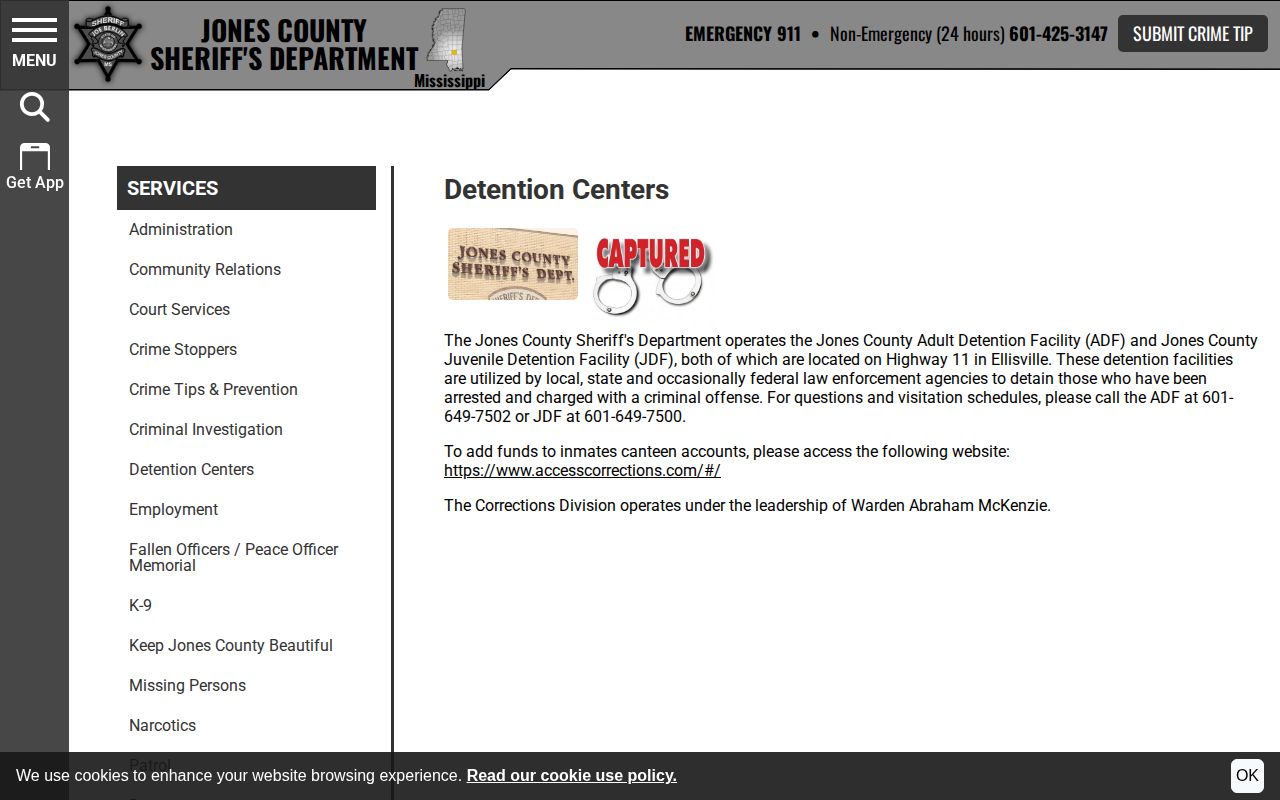
The captured official page supports the ADF operator and contact facts; it does not supply release logistics that the sheriff has not published.
Jones ADF Agency Handoffs
ADF's service to local, state, and occasional federal agencies creates a distinctive release-record issue. Leaving the county roster may be an agency handoff. If the public card lacks a destination, ask for the receiving agency by name and the movement entry that documents the transfer. “Released to MDOC” means county custody ended while state incarceration began or continued. A federal handoff may require the federal detention or commitment order because USMS does not offer a general public person locator.
An immigration detainer can also redirect an expected exit. Research did not verify an ICE detention contract at ADF, so occasional federal use must not be turned into that claim. Ask whether a hold existed and whether DHS took custody. Then use ICE's locator with the right identity fields. An ICE transfer is not a community release in Jones County.
Jones ADF Release Logistics
No official source reviewed published a release door, regular release time, property-return process, weekend or holiday rule, transportation arrangement, family waiting rule, or release fee. These gaps should remain explicit. Call 601-649-7502 for current instructions tied to the specific booking, and do not assume a practice used at another Mississippi jail applies in Ellisville.
A court may order release before jail staff finish identity checks, paperwork, property handling, or other lawful processing. No fixed lag was published. If a timestamp has not appeared, check again and contact ADF. Ask whether the person remains in Jones custody, whether another hold exists, and which office can confirm the completed release event.
Read Jones ADF Records Carefully
A listed charge is an allegation, not a conviction. A bond amount does not prove bond caused the exit. The sheriff warns that charges and bail can change after court appearances, so the court file and official release code are needed for the legal outcome and mechanism. Jones County has two court districts. When no cause number is available, the arresting agency and filing dates can help identify whether the Ellisville or Laurel clerk holds the case.
Online visibility is temporary. The sheriff calls its public product a 48-hour release view, while no guaranteed older-profile archive or local retention term was found. The government record may continue after the card leaves the feed. Preserve the booking number, request the underlying record, and state the scope and date of any official response.
Jones ADF Release Evidence
Build the result around five facts: the matched person, the exact booking, the agency ending custody, the next destination, and the record that proves each point. A name is weak by itself. Booking number, date of birth, photograph, cause number, and date range reduce the risk of joining two people's records. The certified movement or release record ranks first. The live sheriff card is a strong recent lead. A VINE alert reports a participating agency's change, while a court order explains legal authority. None should be made to perform another record's function.
If two sources conflict, note when each was checked. A court order can precede jail processing. VINE may post after the transaction. A receiving agency may not show intake at once. Ask the custodian with the operative record rather than choosing the result that seems most likely. A sound finding can be community release, continuing custody with a named agency, or unresolved pending an official response.
Follow Jones Release Custody
Start with the last known event and move forward one custodian at a time. For a recent ADF booking, record the exact release time and booking number. If the official movement record names MDOC, search the state ID and Location after intake. If it names USMS or BOP, use the federal docket and locator. If it names ICE, use the A-number route and federal detention contact. If no receiving agency appears, compare the court order and ask ADF whether the event was a community exit. This sequence keeps a transfer from being mislabeled as freedom and keeps a county record from being stretched beyond its scope.
When the next source has not updated, retain the earlier record and check again. State the end of Jones custody only. Do not claim the next status until the receiving agency or court supports it. This approach is slower than a one-screen search, but it answers the actual release question and preserves the key distinction between leaving ADF and leaving all custody.