
Jones County Projected Versus Actual Release
Mississippi's public MDOC detail uses the exact label Tentative Release Date. The word tentative is essential. It describes a date calculated from the sentence information, credits, eligibility rules, and status known to MDOC at that point. It can move. A future tentative date is not proof that release will occur that day, and a past tentative date without an updated status is not proof that it already happened.
An actual release is a completed custody event. For the Jones County Adult Detention Facility, the sheriff's timestamped Released profile is a strong timely lead for the end of the county booking, while the official jail release or movement record can give the release code and destination. For a state prisoner, an MDOC discharge certificate or official release record is stronger than a tentative date. A community location such as ERS may establish physical release while the sentence and MDOC jurisdiction continue.
Pretrial custody works differently. A person awaiting a Jones County case does not have a sentence-based release date to calculate. Bond conditions, court orders, dismissal, transfer, and holds may control the next event. The court record explains legal authority, but the jail log is stronger for the precise physical exit time.
Find a Jones County Release Date
Begin with the last known custodian. The MDOC search does not cover every person who spent time in the county jail, and the Jones County Released list does not establish a later state-prison discharge. Collect the exact name, booking number, MDOC ID, court cause number, conviction county, and sentence date as lawfully available. These identifiers prevent a date from the wrong custody episode from being attached to the person.
- Decide whether the person is a pretrial or county-jail detainee, an MDOC prisoner, someone under community supervision, or a federal or immigration detainee.
- For MDOC custody, search the official inmate database by MDOC ID when possible. Otherwise compare name results carefully.
- Open the detail record and read Location, Unit, Location Change Date, sentence data, and Tentative Release Date together. Do not copy the date without its label.
- For Jones County jail custody, call ADF and check the court record. Ask whether a date is tied to a sentence, bond event, pending order, or transfer.
- For proof after the event, request the jail movement or release record, or submit a written MDOC request for the discharge certificate and actual release data.
The MDOC inmate search form is the official public starting point for state-sentenced people.
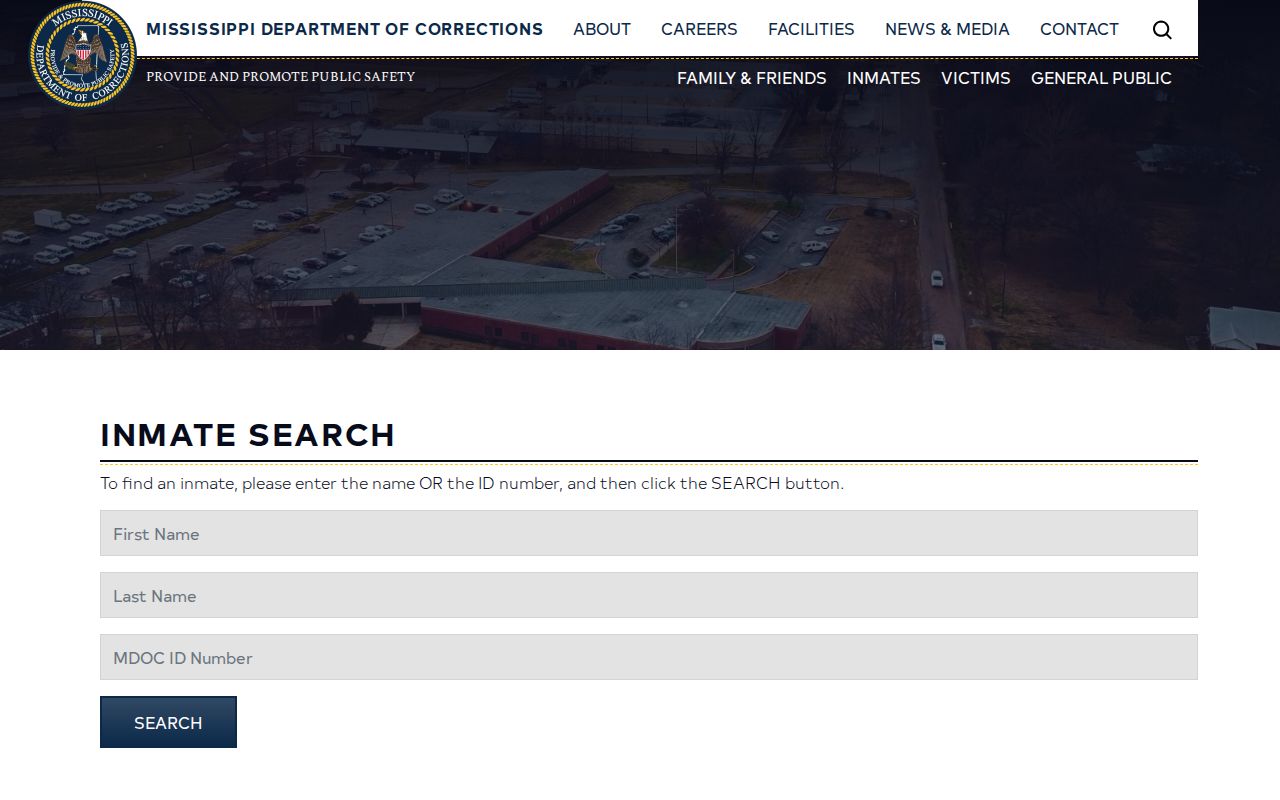
The form accepts a first name, last name, or MDOC ID, but its results describe state corrections records rather than all Jones County bookings.
Note: Use a Jones booking number for the county episode and an MDOC ID for the state episode; the two records answer different questions.
Jones County MDOC Release Date Fields
The MDOC detail contains more than one clue. Location can show a prison or a community status. Sentence count and total length describe the sentence structure at a high level. Offense, county of conviction, and sentence date help match the correct case. None of those fields should be read alone. Fully discharged historical persistence and a dependable literal public Discharged field were not verified in the live system.
| MDOC field | How it affects a Jones County date inquiry |
|---|---|
| MDOC ID | Separates similar names and ties the detail to the state record. |
| Location and Unit | Distinguish prison placement from a community designation such as ERS. |
| Location Change Date | Shows when MDOC recorded a placement change, not necessarily full discharge. |
| Sentence count and total length | Warn that multiple or structured sentences may affect computation. |
| Offense and conviction county | Help match the detail to the Jones County court case. |
| Tentative Release Date | MDOC's changeable public projection, not an actual release certificate. |
The manifest image below comes from an official MDOC detail-page example selected to show the public field layout.
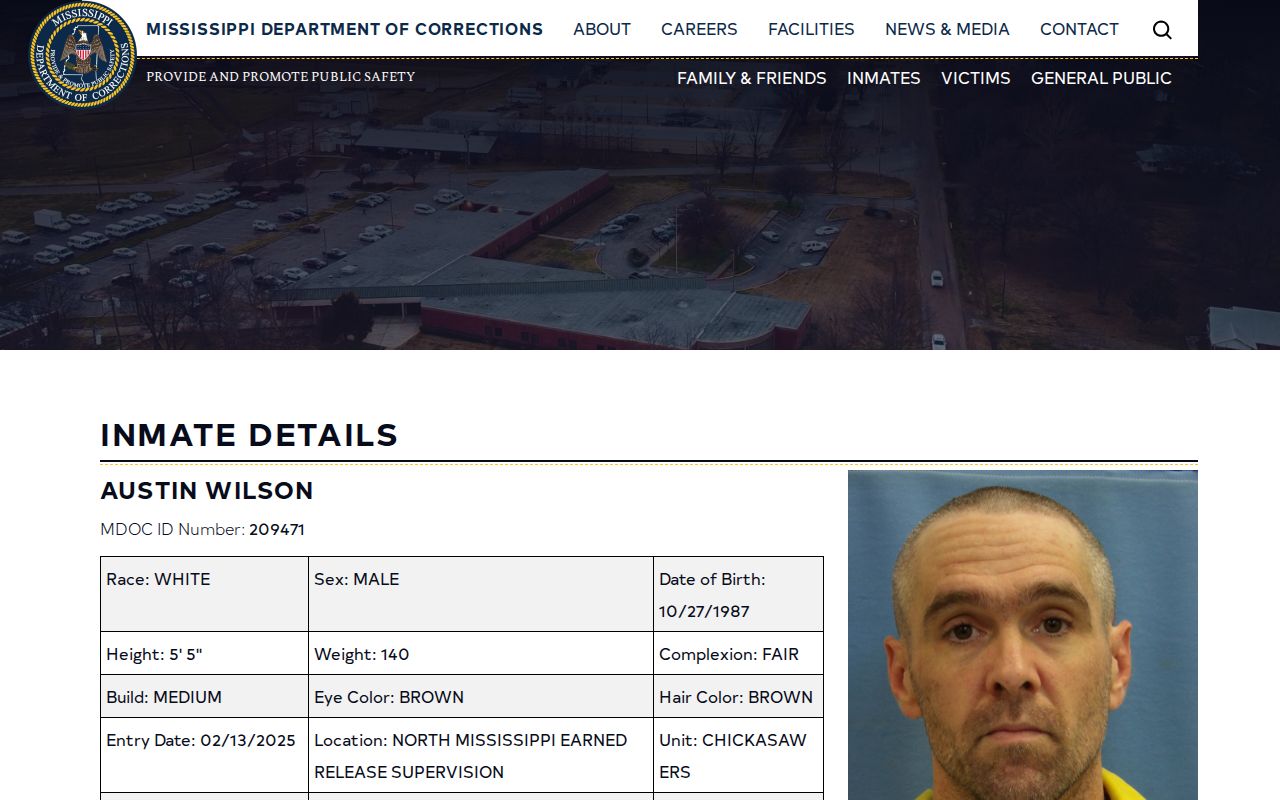
The useful lesson is the relationship among Location, sentence fields, and Tentative Release Date, not the current personal facts in a live example.
Jones County MDOC Date Computation
The MDOC Inmate Handbook says the agency computes parole, ERS, tentative release or discharge, and maximum dates. Eligible pre-sentence or pretrial jail credit tied to the current cause may be deducted to establish the sentence-begin date. A person can also have several sentences running concurrently or consecutively. Raw sentence length is therefore not enough for a reliable hand calculation.
Mississippi Code § 47-5-138 provides regular earned time for covered sentences after the statutory date at 4.5 days for each 30 days served, generally capped at 15 percent. The credit depends on conduct and performance and may be forfeited. Early release under that provision becomes earned-release supervision, with inmate status continuing until sentence expiration. Section 47-5-138.1 addresses potential trusty-time reductions for eligible participation and contains exclusions.
The often repeated 85 percent shortcut comes from a specific earned-time context. It is not a universal rule for every Mississippi sentence. Offense date, classification, exclusions, sentence structure, jail credit, discipline, and later orders matter. A safe answer reports the official MDOC field and asks MDOC for the releasable timesheet or computation record rather than subtracting a flat percentage.
A useful computation request names the person and MDOC ID, then asks for the current releasable timesheet, sentence-begin calculation, applicable jail credit, concurrent or consecutive sequence, earned or trusty credit, forfeitures, and each date label. It should also ask which order supplied the sentence data. This does not ask the reader to perform MDOC's work. It creates a record trail that can explain why the public tentative date differs from an older court estimate or family recollection.
- Jail credit
- Eligible time tied to the current cause that may shift the computed sentence begin date.
- Concurrent
- Sentences structured to run at the same time.
- Consecutive
- Sentences structured to run one after another.
- ERS
- Community release under MDOC authority while statutory inmate status continues.
Jones County Minimum-Service Release Rules
Mississippi Code § 47-7-3.2 sets different minimum-service tiers for covered crimes committed on or after its stated date. The research identifies a general nonviolent tier of 25 percent or ten years, whichever is less; a crime-of-violence tier of 50 percent or twenty years; and a 60 percent or twenty-five-year tier for armed robbery, drive-by shooting, and carjacking. Categorical exceptions and separate rules remain important.
Section 47-7-3 governs parole eligibility and exclusions. Habitual, life, sex-offense, trafficking, violent, and other specially treated categories can change or bar an expected path. Legislative provisions may also be time sensitive. A person-specific release estimate should come from MDOC or the Board's current computation, not a chart applied without the offense date and legal category.
Parole eligibility is only a chance for consideration. It is not a grant. A Board grant is also not the door time because plan approval, processing, detainers, or other custody can intervene. These steps explain why projected release, conditional release, and actual discharge need different labels.
Note: Minimum-service tiers and earned-time credits are separate legal parts of a sentence computation, and neither supports a universal percentage claim.
Why Jones County Release Dates Change
A tentative date moves when the facts feeding the computation change. Some changes add valid credit. Others remove credit, alter sentence structure, delay an approved community plan, or route the person to another custodian. The public field may lag a new order, so the date and Location should be checked again after any known case event.
| Factor | Possible effect | Record to check |
|---|---|---|
| Jail credit correction | Shifts the calculated sentence start | Judgment, jail-credit record, MDOC timesheet |
| Amended judgment | Adds, removes, or restructures time | Current court order and MDOC recalculation |
| Earned or trusty time | Changes eligible credit | MDOC institutional and computation record |
| Discipline | Can forfeit earned time | MDOC official record |
| Concurrent or consecutive terms | Changes when one or more terms expire | Operative judgments and MDOC sentence data |
| Detainer or warrant | Can redirect custody after one term ends | Movement record and receiving agency |
| Parole action or revocation | Changes conditional release prospects or custody | Board action, court record, and MDOC status |
Release-plan residence review can also slow ERS processing. A new charge, sentence, or revocation can keep or return a person to confinement. Administrative checks must be complete before MDOC issues a discharge certificate. The agency's FAQ says release processing can take 30 to 45 days, but that range must not become a guaranteed countdown for an individual.
Jones County Tentative Release Date Limits
Jones County date searches have a distinctive wording problem. The public MDOC field says Tentative Release Date, while the strongest proof after release is an official certificate or release record. Changing the label to actual, scheduled, or guaranteed removes the warning built into the state source. Preserve the field name whenever a date is reported.
Modern minimum-service tiers also make a one-size-fits-all 85 percent statement misleading. Even regular earned time sits inside its own eligibility, conduct, cap, and forfeiture rules. The correct path is to identify the sentence and offense dates, read MDOC's current result, and request the underlying time-computation record when the reason for the date matters.
The MDOC FAQ adds the operational layer: parole and ERS dates are not guaranteed, release plans may need review, and a discharge certificate must be issued. Those facts make a tentative date useful for planning, but not sufficient to announce that a person has left custody.
Jones County court records can also change the inputs. A sentencing order may impose a split sentence, suspended time, probation, post-release supervision, or credit. A later revocation or amended order may replace part of the earlier plan. Match the current operative judgment to MDOC's calculation before treating an old date as current.
Confirm Jones County Actual Release
For a county-only booking, use the Jones sheriff's Released profile and ask ADF for the official release or movement record. Request the timestamp, stored release code and its definition, destination or receiving agency, holds at departure, and court-order reference. A transfer to MDOC, another county, USMS, or ICE ends the Jones booking but does not mean community release.
For an MDOC sentence, ask through the written public-record request route for the discharge certificate, actual release or discharge date and type, movement history, and releasable time-computation record. MDOC does not accept telephone public-record requests. A community Location paired with agency confirmation supports physical release under supervision, while the certificate best supports completed discharge.
VINELink adds notice, not final proof. Register on the correct participating record and then verify an alert with the reporting agency. The Jones County VINELink Release Check explains one-person matching, phone PIN steps, and transfer-linked registration. When sources conflict, preserve each source's timestamp and ask the custodian of the operative record.